
Übersicht

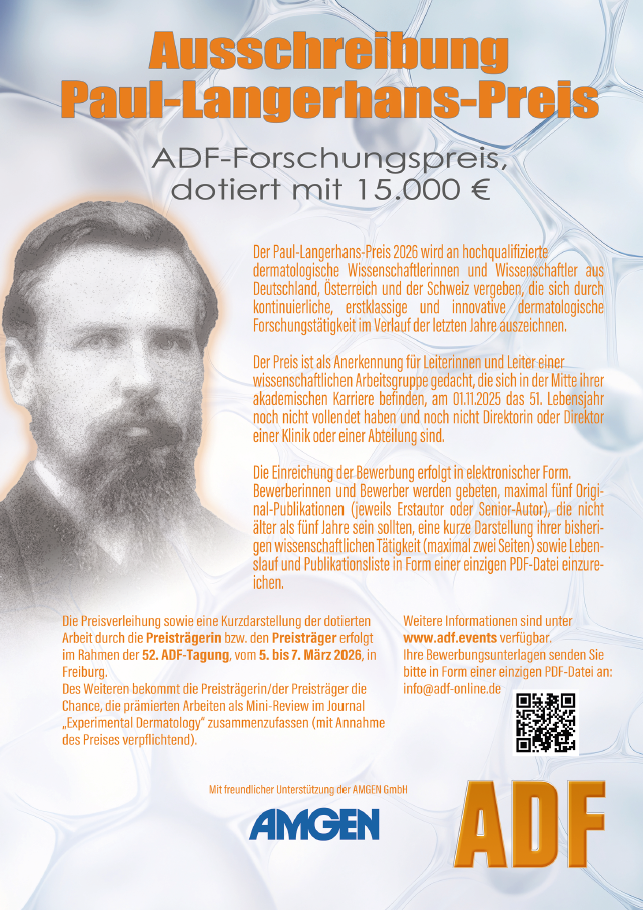
Paul Langerhans Award of the ADF
- Research award, donated Amgen GmbH -
- To support scientific research in dermatology, the ADF announces since 2003 a yearly research award. This award is given to highly qualified dermatological scientists in Germany, Austria or Switzerland who are in the middle of their academic career and who distinguished themselves with continuous, excellent and innovative research over the past years.
- This ADF research award is endowed with EUR 15.000, - and can be shared by two researchers. If the scientific board of this award does not nominate a candidate, the provided amount will be saved to increase the award in one of the following years.
- Members of the ADF aged 50 or below who have not been an ADF awardee before can apply for the Paul Langerhans Award. Applicants should lead their own scientific group, but should not be director of a department. Only the applicant but not his/her co-authors must be members of the ADF.
- Only publications with the applicant being first or senior author, but not co-author can be taken into account for the Paul Langerhans Research Award. The submitted publications (maximum of 5) should not be older than 5 years. If the papers are in press a letter of acceptance needs to be provided.
- The majority of the scientific work should have been conducted at a dermatological research institution in Germany, Austria or Switzerland.
- A PDF of the publication needs to be sent electronically to the ADF office until Nov. 1st of the previous year. In addition a short description of the scientific career and a short CV with a publication record should also be provided electronically (as pdf-file). The submission must be combined into a single pdf-file.
- The ADF office checks the submission for formal correctness and for accordance to the statutes. It rejects incorrect applications and transmits formally suitable applications to the scientific board of trustees.
- The scientific board of trustees suggests one candidate awardee to the executive board of the ADF. Assessment criteria are: overall scientific merit of the applicant; relevance, novelty, originality and complexity of the achieved scientific results; scientific quality of the publications (journal impact factors, number of citations of the publications)
- Those members of the scientific board of trustees who are co-authors of submitted work or belong to the same department or institute as the applicants do not vote for the respective publications.
- The awardee is chosen by an independent board of trustees, which is elected by the executive board of the ADF each five years. The final decision is made by the executive board of the ADF which usually follows the suggestion of the board of trustees unless severe doubts are brought forward and discussed.
- The award is presented during the Annual ADF Meeting.
- The awardee is asked to publish a mini review at the ADF home journal Experimental Dermatology (mandatory with acceptance of the award).
Scientific board of trustees:- Prof. Dr. Alexander Navarini (Chair)
- Prof. Dr. Amir Yazdi
- Prof. Dr. Carola Berking
- Prof. Dr. Cyrill Géraud
- Prof. Dr. Wolfram Hoetzenecker
- Prof. Dr. Birgit Schittek
- Prof. Dr. Stefan Weidinger
- Prof. Dr. Peter Wolf
Bisherige Preisträger des Paul Langerhans Award of the ADF
2025
Georg Stary, Vienna
Georg Stary, Vienna
2024
Christoph Schlapbach, Bern
Christoph Schlapbach, Bern
Regulation of T helper cells in inflammatory skin diseases
2023
Patrizia Stoitzner, Innsbruck
Patrizia Stoitzner, Innsbruck
The role of dendritic cells in the immune response against melanoma.
2022
Patrick Brunner, Vienna/New York
Patrick Brunner, Vienna/New York
2021
Diana Dudziak, Erlangen
Diana Dudziak, Erlangen
2021
Cyril Géraud, Mannheim
Cyril Géraud, Mannheim
2020
Claudia Günther, Dresden
Claudia Günther, Dresden
2020
Christina Zielinski, München
Christina Zielinski, München
2019
Stefanie Eyerich, Munich
Stefanie Eyerich, Munich
Pathogenesis and molecular diagnosis of chronic inflammatory skin diseases
2019
Michael Hölzel, Bonn
Michael Hölzel, Bonn
2018
Enno Schmidt, Lübeck
Enno Schmidt, Lübeck
Autoimmune blistering dermatoses
2017
Thomas Wiesner, Vienna
Thomas Wiesner, Vienna
Deciphering the Molecular Mechanisms of Skin Cancer
2016
Stephan Weidinger, Kiel
Stephan Weidinger, Kiel
Molecular mechanisms of inflammatory skin diseases
2015
Kilian Eyerich, München
Kilian Eyerich, München
Immunology of chronic inflammatory skin diseases
2014
Kamran Ghoreschi, Tübingen
Kamran Ghoreschi, Tübingen
Molekulare und zelluläre Analysen von adaptiven Immunantworten
2013
Christian Hafner, Regensburg
Christian Hafner, Regensburg
Onkogene Mutationen bei epidermalen Nävi und seborrhoischen Keratosen
2012
Kerstin Steinbrink, Mainz
Kerstin Steinbrink, Mainz
Mechanismen der immunologischen Toleranz
2011
Mark Berneburg, Tübingen
Mark Berneburg, Tübingen
Biologie und Pathologie UV-induzierter Effekte auf die Haut
2010
Ingo Haase, Köln
Ingo Haase, Köln
2009
Stefan Martin, Freiburg
Stefan Martin, Freiburg
2008
Ralf Paus, Lübeck
Ralf Paus, Lübeck
2007
Dieter Maurer, Wien
Dieter Maurer, Wien
2006
Michael Schön, Würzburg Alexander Steinkasserer, Erlangen
Michael Schön, Würzburg Alexander Steinkasserer, Erlangen
2005
Helmut Jonuleit, Mainz Stephan Beissert, Münster
Helmut Jonuleit, Mainz Stephan Beissert, Münster
2004
Jürgen C. Becker, Würzburg Martin Steinhoff, Münster
Jürgen C. Becker, Würzburg Martin Steinhoff, Münster

